A great battle is now in progress in our American culture. It is a battle that has been going on for perhaps half a century now. Unfortunately the spiritual forces opposing belief in God and all that comes with it have been winning this battle.
At present many wonder why we are seeing the majority of our own youth abandoning their faith as they leave home. Perhaps it is because they have no deep conviction about the existence of God and the absolute necessity of seeking Him with all their hearts and lives (Hebrews 11:6).
Vine’s Expository Dictionary of Old and New Testament Words should be one of the most treasured books in any serious Bible student’s library – it certainly is in mine. (Note that EBS may earn a small commission off any merchandise purchased through links on this page.) It has gone through numerous editions since its introduction around 1940. More recent editions have added Old Testament words to the original New Testament only version. My first mentor, James Wilson, introduced me to the use of this resource before I had even decided to be a preacher of the gospel. Here are some of the great benefits of using this book properly:
The Internet is everywhere in our lives these days. Whether it be at home, school, restaurants, bookstores ÂÂÂor even in our churches, people have come to rely on having fast, stable access to the Internet.ÂÂ Recently, I began looking for a way to extend my high-speed internet connection at home out to the far edges of my home. Like many, our internet connection is brought into our home at one corner of the house and the speed and stability of the connection degrades the further away you get from the Wi-Fi router.
Without argument, more paintings, drawings, images and statues have been made of Jesus than of any other person who has ever lived! Early catacomb images pictured Him with short hair and clean-shaven. Western artists of the Middle Ages up until today give Him longer hair, a beard, and more Western European features. But the truth is, the eye-witness records do not give us one shred of evidence about his actual appearance. Why? The answer is not clear. But this is clear: the gospel writers were not interested in what He looked like – they wanted everyone to know what He WAS like! Welcome to our study entitled, “Portraits of Jesus.”
Like many others, I was affected and convicted deeply many years ago by a little novel written in 1896 by Charles Sheldon entitled, In His Steps. In it he imagined how Christians might act differently if, in any given situation, they would ask themselves, “What would Jesus do?” Even today we encounter the “WWJD” thinking. But that novel left a big question in my mind at the time – “How can I really know what Jesus would do?” This led me to the following title which has had an even greater impact on my understanding, life and teaching than In His Steps. It is a book which actually answers in large part the central question raised by In His Steps.
My parents were baptized and became New Testament Christians when I was five years old. From that time on I was (and have been) in Sunday School and worship assemblies without fail. Being constantly exposed to Bible teaching is one thing. Knowing how to study on my own was quite another.
At Florida College I was required to take a course called Hermeneutics, taught by Roy Cogdill. I do not believe I had ever heard the word “hermeneutics” before that time. But that course and its textbook completely changed my understanding of the Bible and how to study it.
This is the first of what will be an ongoing series of podcast reviews. These reviews will focus on podcasts that we have discovered that offer something that we believe our readers will find useful, enriching, or at the very least, entertaining.
Podcasts, for those who are not aware, are essentially audio shows that can be listened to “on-demand” via most phones, tablets and computers. There are a vast number of different podcasts available covering just about any topic that can be imagined. The show that I would like to introduce you to today is called Three Chords and the Truth: The Apologetics Podcast.
As I look back over 50+ years of Bible-based training, studying and ministry, there are a few books that have had a profound effect on my thinking. This is the first of several posts on some of those books, and why they impacted me. Note that EBS may earn a small commission off any merchandise purchased through links on this page.
Evidence That Demands a Verdict, by Josh McDowell. This was not the first book on Christian evidences I bought, but it was the most comprehensive and logically compelling. The foundation tenets of the Christian faith are rooted in history. While some appeal to “science” as if it is the be all and answer to all, much of what we all know and/or believe is rooted not in science (a fairly recent invention as we know it), but in history – evidences, eyewitnesses, documents, monuments, etc.
“You made the best case you knew how, and your friend still wasn’t persuaded to follow Christ. Why is it that solid, rational arguments for the Christian faith often fail?” – James Sire
Rather than focusing on the various arguments which constitute the broad topic of “Christian Evidences,” James Sire devotes most of his book to the topics of logic and why people are (or are not) persuaded to accept a different point of view.
“Therefore we have been buried with Him through baptism into death…so we too might walk in newness of life” – Romans 6-4
First Steps: Beginning Studies for Those New in the Christian Faith, by Richard Cravy
This study outline is for both personal and group study with an emphasis on those new to Christianity. First Steps features 15 lessons in 4 sections. Each lesson is designed to be self-contained and used as a weekly lesson for a class format.
The four sections of First Steps are:
First Steps to Understanding the Bible
First Steps in Christian Evidences
First Steps to Understanding Salvation
First Steps in Christian Living
It was developed for study in a New Christians’ Class setting, to help new believers to understand the foundation on which they stand, how they were saved, and how to find a place of service as members of the Body of Christ.
A wonderful set of DVD videos which present the historical world of the Bible is “Drive Thru History” with Dave Stotts. Sponsored by Focus on the Family and produced by Coldwater Media, this a technically well done series. DVD sets are available covering Ancient Rome, Turkey, Greece. A great series of DVDs on the Gospels and another set covering Acts Thru Revelation are both very good. A subscription service is also available allowing all of the videos to be accessed over the internet.
Designed for use in home schooling, Christian schools, or Bible classes, the intended audience seems to be high school age and above.
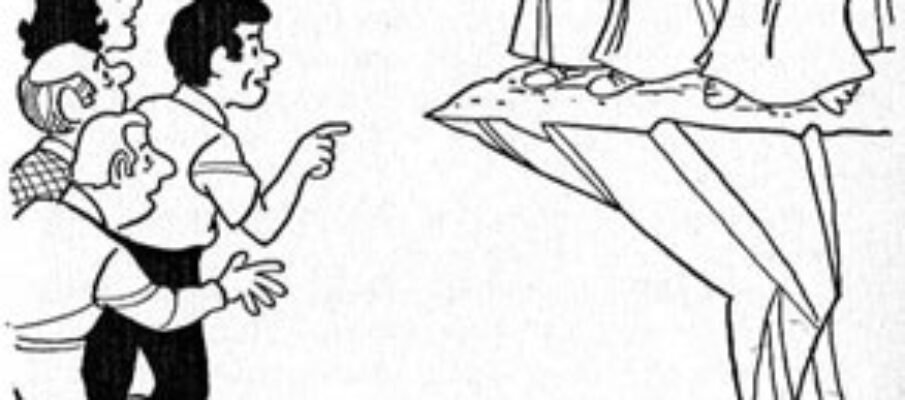
A most basic element of effective Bible study is illustrated well in this drawing taken from Getting More From Your Bible, by Terry Hall. Understanding the history, culture, background, language, and even geography surrounding a biblical author’s writing will make it more likely we will accurately interpret what he has written.
We plan to continue with more articles illustrating and expanding on this basic principle – that an author is always writing within a context. Each biblical writer’s original audience was very aware of that context, and needed little or no explanation from the author. Today, we need to practice “due diligence” and, as much as possible, put ourselves into the same position as the original recipients of the writing.
Here is a non-religious example to illustrate. Looking through some personal papers once belonging to your great grandmother you find a letter. As you scan its contents you notice a number of things. It is addressed to someone whose name you do not recognize named Martha. The date is in the early 1860s. The address is in South Carolina. The contents are a mixture of personal expressions of longing and fondness along with references to war. With the clues referred to we would correctly conclude that the setting was the American Civil War in the South, and this was a letter home from a soldier. Without these basic bits of background (context), much of the real message of the letter would be lost. The same is true of the Scriptures. More to come. . .
(Getting More From Your Bible, by Terry Hall was copyrighted 1984 and published by Victor Books. I have not been able to locate the author to gain his permission to use this drawing. I have kept this book these 20+ years because of its contribution to effective Bible study.)


 “Therefore we have been buried with Him through baptism into death…so we too might walk in newness of life” – Romans 6-4